
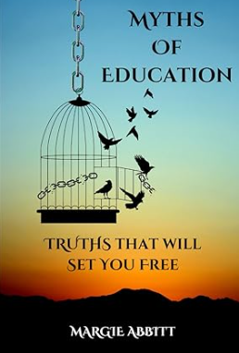
Myths of Education: Truths That Will Set You Free
By Margie Abbitt, Abbitt Educational Services, 2024
Margie Abbitt convinced this reviewer from her book’s Introduction that it might contain worthy information when Abbitt acknowledged that John Taylor Gatto’s book, The Underground History of American Education, would be “a great resource” on the subject of “factory model schools” and “industrial-era schools.” After all, Phyllis Schlafly was a fan of Gatto, who once observed for example: “It is unbelievable that parents are willing to turn their children over to strangers for 8 hours a day to teach them material they often disagree with.”
In Myths of Education, Abbitt contends that the process of educating children is inherently different from the actual “schooling” experience and that parents should discard most of the notions they have about how children should be taught. She believes many of the long-standing assumptions about education are instead limiting “myths.” Built around a series of fetching personal anecdotes, her book is both an encouragement and a “how to” for parents to take a totally different path with their children than most of them took themselves growing up.
 Abbitt leads the reader through the myths in a logical yet entertaining way. The first myth she discusses is “Education is too complicated for parents. It takes people with degrees to educate.” She then shows why this is not so; that “parents become teachers” when their first child is born.
One anecdote mentions a family member who vocally opposed her decision to homeschool, yet lamented to her about how much time she spent with her daughter doing homework after the school day. Abbitt writes: “I realized she was really homeschooling at night, and I was homeschooling in the morning during the best hours of my child’s day.”
Abbitt observes that “parents are generally the best people to oversee and make decisions about their children’s education because no one else is typically going to care more.... Having a college degree doesn’t guarantee a better education. This doesn’t mean parents won’t use other teachers, resources, schools, etc. to be a part of their plan.”
The conversational tone of the book makes for engaging reading. The author’s personal experiences include the funny, the scary, the poignant, and the memorable, many of which will resonate with readers’ own experiences. She peppers the narrative with the “truths” she has discovered through her years of home education that contradict the “myths.”
One of Abbitt’s key themes is that education should adapt to the child, rather than the child to a rigid schooling schedule. She refutes the notion that more hours in the classroom automatically mean better outcomes, or that the traditional classroom structure is always best. In this way, she helps parents consider how their children learn, and how they might be more responsive to flexible, individualized instruction.
Although the author covers many “myths” she encountered during her home education journey, following are some of the most common themes that appear throughout her book:
- Traditional schooling is the only pathway: Abbitt believes the idea that children must attend school in a conventional classroom setting, with a certified teacher, and that deviation is risky for the child is a myth. She counters by giving examples of positive homeschooling experiences.
- The “one size fits all” education is best: This myth suggests that the same curriculum, pacing, and structure works for all students. The author makes a compelling case for individualized learning that adapts to a child’s strengths and interests.
- More time = more learning and more schooling = better outcomes: This myth contends that simply increasing hours, subjects, and homework will automatically lead to better outcomes. Abbitt explores how quality, choice, and relevance matter more than quantity and achieve better results.
- Credentialed teachers guarantee quality: While certificates and formal training are beneficial, they are not the whole story. Abbitt shows how parent-teachers, community learning, mentoring, and interest-driven projects can yield exceptional learning.
- Schooling equals learning: This myth implies that being in a school classroom automatically means the child is learning. Abbitt emphasizes that learning happens in many places, at different times, and takes many forms, and that schooling should be viewed as one of multiple possibilities.
- The standardized path is the path to success: The assumption that children must follow a prescribed path (school → college → career) to succeed is a myth, Abbitt writes. The book explores alternatives such as apprenticeships, self-directed learning, and skill-based pathways.
Myths of Education is a thought-provoking, entertaining, and practical read for parents who are exploring the possibilities of homeschooling or are already engaged either in homeschooling or other alternative education models. The book offers a refreshing counter-narrative to thwart the typical schooling assumptions, and suggests questions to ask and structures to reconsider. It’s also likely to motivate parents already so inclined to take greater ownership of how their children are taught.
And the book is a must read for parents seeking practical advice and direction about an educational alternative that may actually fit with their belief system and their vision for their child’s future. However, those looking for a research-driven analysis of education policy may be disappointed.
This reviewer found Abbitt’s book refreshing and full of promise for parents seeking to take control of their children’s education; that they can be the most capable educators, and that teaching their children can be a flexible, enjoyable, and rewarding experience.
To read the entire book, go to Amazon to order!
Want to be notified of new
Education Reporter content?
Your information will NOT be sold or shared and will ONLY be used to notify you of new content.
Click Here
Return to Home Page